Edit Content

4B, Dr. Martin Luther King Sarani (Wood Street), 2nd Floor, Kolkata – 700016

Subscription Form

Search engines are no longer just matching keywords – they are understanding meaning, context, and intent. This shift is powered by vector search SEO, a technology that allows search engines to interpret content in a more human-like way. As Google continues to evolve with AI-driven algorithms, understanding vector search has become essential for businesses that want to protect and grow their organic rankings.

 This guide explains what vector search is, how it works, and why it plays a critical role in modern SEO strategies.

What Is Vector Search?

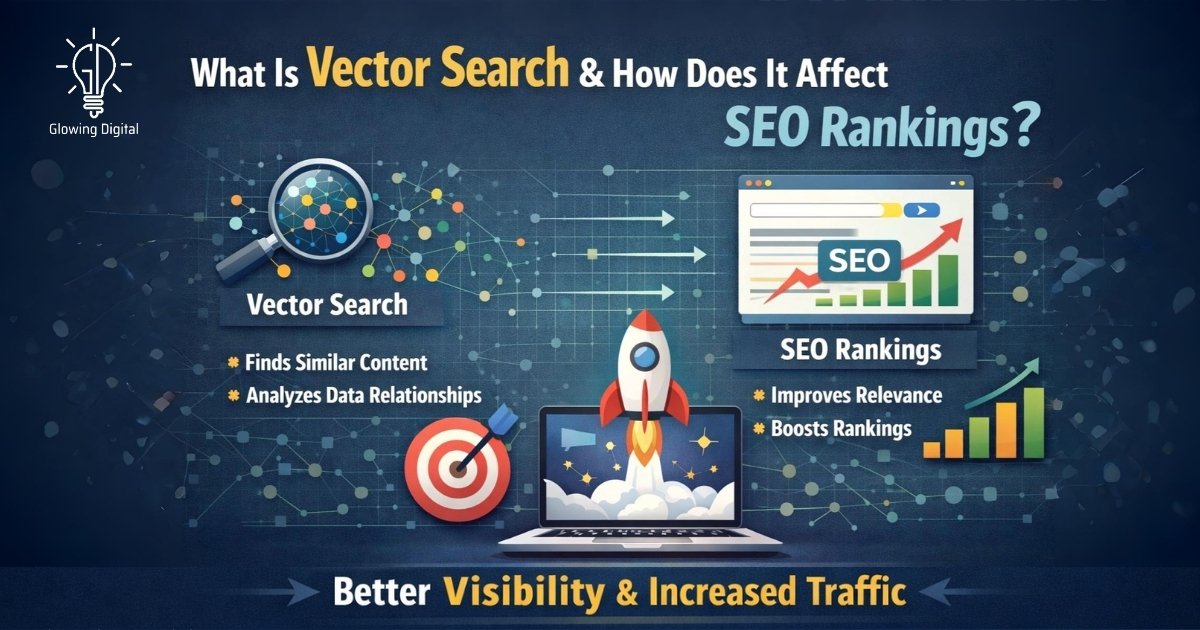
Vector search is an advanced search method that converts words, phrases, and entire pieces of content into numerical representations called vectors. These vectors capture semantic meaning rather than exact keyword matches. Instead of asking, “Does this page contain the keyword?”, search engines ask, “Does this page mean the same thing as the query?”

This enables more accurate, relevant results – especially for conversational, complex, or ambiguous searches.

How Vector Search Works in Search Engines

Search engines use machine learning models to analyze language patterns, relationships, and intent. Content is processed into vectors that represent meaning, tone, and topical depth. When a user enters a query, the search engine compares vectors to find the closest semantic match.

This process supports semantic search and SEO, where relevance is determined by context rather than keyword density. Pages that comprehensively answer a topic – using natural language – are more likely to rank higher.

The Role of Vector Embeddings in SEO

At the core of vector search are embeddings. Vector embeddings for SEO help search engines understand how different concepts relate to each other within your content. For example, a page about “technical SEO” doesn’t need to repeat the phrase constantly if it naturally covers crawlability, indexing, site architecture, and performance.
Well-structured content with topical depth sends stronger relevance signals and improves discoverability across a wider range of related queries.

How Vector Search Changes Ranking Factors

Traditional ranking signals like backlinks and keywords still matter, but they are now supported by deeper contextual analysis. Semantic search ranking factors include topical authority, content clarity, internal linking logic, and how well a page satisfies search intent.
Thin content, keyword stuffing, or shallow answers struggle to perform because vector search prioritizes meaning over repetition. Pages that provide genuine value, examples, and structured explanations benefit the most.

Optimizing Content for Vector Search

To succeed in a vector-driven search environment, SEO strategies must evolve. This is where AI search optimization strategies come into play. Focus on writing content for humans first, using natural language, related terms, and clear structure. Use headings to break down topics, add internal links for context, and answer real user questions directly.
Content clusters, topic hubs, and well-organized blogs signal expertise and help search engines understand how your content fits into a broader subject area.

Bottom Line

Vector search is redefining how SEO works by rewarding relevance, depth, and intent alignment. Brands that adapt early will gain a significant competitive edge as search engines become more intelligent. By embracing vector search SEO, businesses can future-proof their content and improve long-term rankings. At Glowing Digital, we help align their SEO strategies with AI-driven search advancements to drive sustainable organic growth.

FAQs

1. What is vector search in simple terms?

Vector search is a method that allows search engines to understand the meaning of content rather than matching exact keywords. It uses AI to compare concepts and intent, helping users find more accurate and relevant results even when queries are vague or conversational.

2. How does vector search affect SEO rankings?

Vector search impacts rankings by prioritizing content relevance, intent satisfaction, and topical depth. Pages that align with semantic search and SEO principles tend to perform better because they answer user queries more comprehensively instead of relying on keyword repetition.

3. Is vector search replacing traditional keyword SEO?

No, vector search does not replace keyword SEO – it enhances it. Keywords still help define topics, but vector embeddings for SEO allow search engines to understand relationships between ideas, making content quality and structure more important than exact phrasing.

4. What content performs best with vector search?

Content that performs best is well-structured, in-depth, and user-focused. Search engines evaluate semantic search ranking factors such as clarity, completeness, and contextual relevance to determine whether a page truly answers the search intent.

5. How can businesses optimize for AI-driven search?

Businesses should focus on AI search optimization strategies like creating topic clusters, answering real user questions, using natural language, and improving internal linking. This helps search engines understand content context and improves visibility across multiple related queries.
Rajveer Mahmia

Rajveer Mahmia is the Founder & CEO of Glowing Digital, a global AI-first SEO agency serving 100+ businesses worldwide. Starting in 2021, he built the agency around the future of search—combining AI SEO, AEO, GEO, LLM SEO, and Google SGE. Rajveer helps brands gain visibility across Google and AI search platforms like ChatGPT, Gemini, and Perplexity through data-driven, intent-focused organic growth systems.