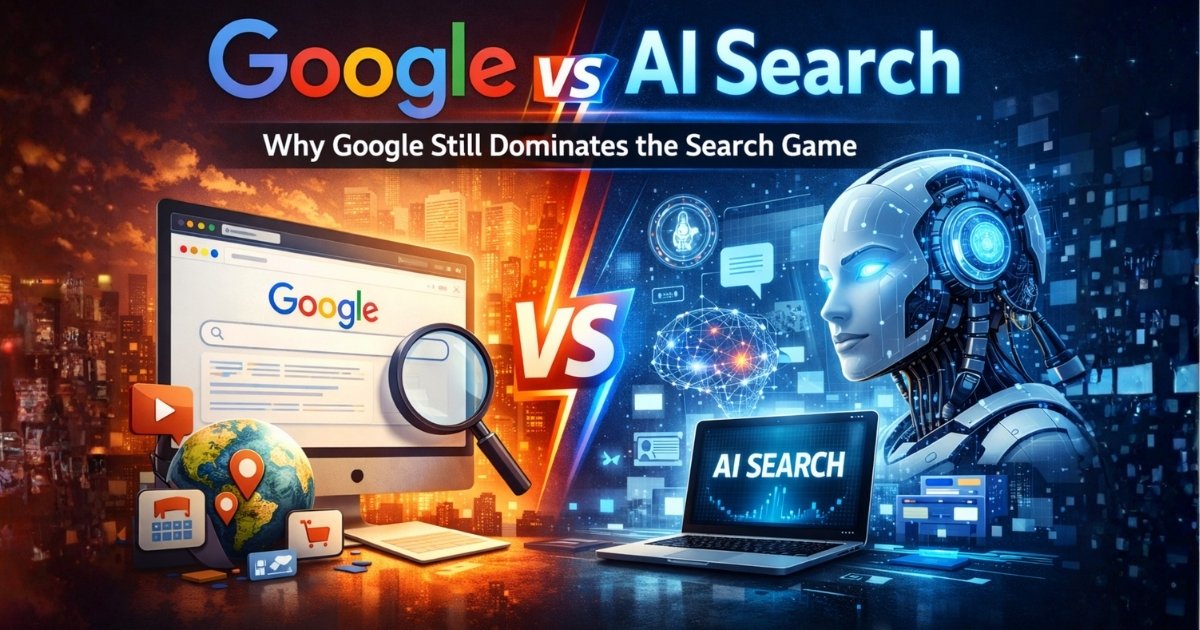
The digital search landscape is evolving rapidly, with artificial intelligence reshaping how users access information. Yet, despite the rise of AI-driven tools, the debate around why Google still dominates search remains highly relevant. While AI search engines offer conversational and intuitive responses, Google continues to lead due to its scale, reliability, and deeply integrated ecosystem.
Understanding Google vs AI Search
The comparison of Google vs AI search highlights two fundamentally different approaches. Google operates on a keyword-based indexing system supported by advanced algorithms, ranking billions of web pages based on relevance and authority. AI search, on the other hand, focuses on generating direct answers using large language models.
While AI simplifies search into a conversational experience, it often lacks transparency in sourcing and struggles with real-time accuracy. Google, however, excels in delivering verifiable results backed by trusted sources, which builds user confidence over time.
AI Search vs Traditional Search Engines
When evaluating AI search vs traditional search engines, it’s clear that both serve different user intents. AI tools are excellent for quick summaries, brainstorming, and natural language queries. However, traditional search engines like Google provide a broader spectrum of information, including news, images, videos, maps, and scholarly content.
Google’s strength lies in its ability to organise the world’s information efficiently. It doesn’t just provide answers – it offers options, perspectives, and sources. This depth is especially valuable for users conducting research, making decisions, or verifying facts.
Why Google Maintains Its Dominance
Several factors explain Google’s continued leadership in the search space:
- Massive Index and Infrastructure: Google indexes trillions of pages, offering unmatched depth and diversity of information.
- Trust and Credibility: Users trust Google for accurate and up-to-date results, especially for critical queries.
- Advanced Ranking Algorithms: Continuous updates ensure high-quality content surfaces first.
- Integrated Ecosystem: Services like Gmail, Maps, and YouTube enhance the overall search experience.
AI search engines, while innovative, are still developing in these areas. They often rely on pre-trained data, which can limit freshness and contextual accuracy.
The Future of SEO and AI Search
The future of SEO and AI search is not about replacement but integration. Google itself is incorporating AI features into its search engine, blending traditional indexing with AI-generated insights. This hybrid model is likely to define the next phase of search evolution.
For businesses and marketers, this means adapting strategies to include both structured SEO practices and AI-friendly content. High-quality, authoritative, and user-focused content will remain essential, regardless of the technology delivering it.
Key Takeaways
As the digital ecosystem evolves, the competition between AI tools and search engines will continue to intensify. However, the reasons behind why Google still dominates search are deeply rooted in trust, scale, and continuous innovation. While AI enhances how we interact with information, Google remains the backbone of reliable search. Companies like Glowing Digital recognise this balance and help brands navigate both traditional SEO and emerging AI-driven opportunities effectively.
FAQs
1. What is the main difference between Google and AI search engines?
Google uses indexed web pages to deliver ranked results, allowing users to explore multiple sources. AI search engines generate direct answers using trained models. This makes AI faster for summaries, but Google remains more reliable for detailed research and accurate, source-based information across different industries and topics.
2. Will AI search replace traditional search engines like Google?
AI search is unlikely to fully replace traditional search engines. Instead, both will coexist and complement each other. The future of SEO and AI search suggests a hybrid model where AI enhances user experience while traditional engines continue to provide structured, diverse, and verifiable information sources.
3. Why do users still prefer Google over AI search tools?
Users prefer Google because it offers multiple sources, real-time updates, and trusted results. AI tools may sometimes provide incomplete or outdated answers. Google’s transparency and ability to validate information make it a more dependable option for important queries, especially in areas like health, finance, and news.
4. How does AI search impact SEO strategies?
AI search is changing SEO by emphasizing conversational and intent-based content. However, traditional SEO practices like keyword optimization, backlinks, and content quality still matter. Businesses must now create content that satisfies both AI-generated responses and search engine ranking factors for maximum visibility online.
5. Is Google adapting to AI advancements in search?

Rajveer Mahmia
Rajveer Mahmia is the Founder & CEO of Glowing Digital, a global AI-first SEO agency serving 100+ businesses worldwide. Starting in 2021, he built the agency around the future of search—combining AI SEO, AEO, GEO, LLM SEO, and Google SGE. Rajveer helps brands gain visibility across Google and AI search platforms like ChatGPT, Gemini, and Perplexity through data-driven, intent-focused organic growth systems.


