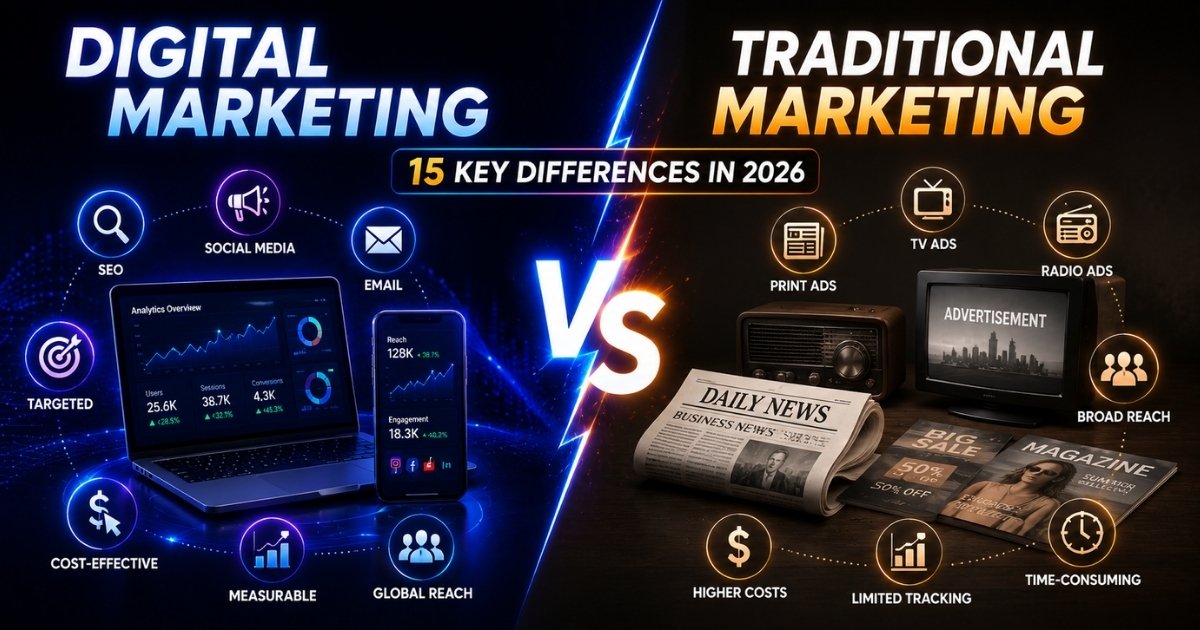
The marketing landscape in 2026 has evolved dramatically, driven by technology, data intelligence, and changing consumer behaviour. Understanding the distinction between digital vs traditional marketing is essential for businesses aiming to stay competitive. Both approaches have value, but their execution, reach, and impact differ significantly in today’s environment.
1. Understanding the Core Approach
At its foundation, digital marketing relies on online platforms such as search engines, social media, and data-driven campaigns. It focuses on real-time engagement, measurable outcomes, and personalised communication. In contrast, traditional marketing uses offline channels like print, television, and radio, often delivering broad, non-targeted messages.
2. Targeting and Audience Precision
One of the most defining differences between digital marketing and traditional marketing is targeting capability. Digital channels allow businesses to segment audiences based on behaviour, demographics, and intent. Traditional marketing lacks this precision, often reaching a wider but less specific audience.
3. Cost Efficiency and Budget Control
Budget allocation has become way more flexible with digital marketing. Campaigns can be adjusted instantly based on performance metrics. Traditional marketing typically requires higher upfront costs with limited scope for mid-campaign changes, making it less adaptable in dynamic markets.
4. Measurability and Data Insights
Modern businesses prioritise measurable results. Digital marketing provides detailed analytics, including click-through rates, engagement levels, and conversion data. Traditional marketing relies on estimations and indirect metrics, making performance tracking less accurate and slower.
5. Speed and Campaign Execution
Speed is a major differentiator in traditional marketing vs online marketing strategies. Digital campaigns can be launched, modified, or paused within minutes. Traditional campaigns, such as print or television ads, require longer planning and execution timelines.
6. Customer Interaction and Engagement
Digital marketing is two-way and interactive. Let customers comment, share and respond in real time. Traditional marketing, however, is a one-way communication channel, which limits real-time interaction and feedback.
7. Personalisation and User Experience
Personalisation is now a key pillar of modern marketing. This change is very clear when you compare digital marketing with traditional marketing. Traditional marketing sends the same message to a large audience, whereas digital platforms leverage data to send personalised messages.
8. Global Reach vs Local Presence
Digital platforms enable businesses to expand globally without physical limitations. A top digital marketing agency in India can help brands reach international audiences effortlessly. Traditional marketing remains more effective for local or regional outreach but lacks scalability.
9. Adaptability to Market Trends
In 2026, adaptability is crucial. Digital marketing allows brands to respond quickly to trends, customer behaviour, and market changes. Traditional marketing struggles to keep pace due to its rigid structure and longer execution cycles.
10. Content Formats and Creativity
Creative flexibility is significantly higher in traditional marketing vs online marketing comparisons. Digital marketing supports diverse formats such as videos, interactive ads, and dynamic content. Traditional formats are limited to static or pre-recorded media.
11. Return on Investment (ROI)
ROI tracking is more transparent in digital marketing than in traditional marketing. Businesses can identify which campaigns generate revenue and optimise accordingly. Traditional marketing makes ROI assessment more complex due to limited tracking tools.
12. Accessibility for Small Businesses
Smaller businesses benefit greatly from digital marketing due to lower entry barriers. Even modest budgets can yield meaningful results. Traditional marketing often requires significant investment, making it less accessible for startups or small enterprises.
13. Longevity and Content Lifespan
Digital content has a longer lifespan, especially when optimised for search engines. Blog posts, videos, and social media content can continue generating traffic over time. Traditional marketing campaigns typically have a fixed duration with limited long-term impact.
14. Trust and Brand Credibility
Traditional marketing still holds value in building credibility, especially through established media channels. However, digital marketing vs traditional marketing shows that online reviews, testimonials, and social proof now play a critical role in shaping trust.
15. Integration and Omnichannel Strategy
Modern strategies increasingly combine both approaches. While digital marketing leads in efficiency and scalability, traditional marketing complements it by reinforcing brand presence across offline channels. This integration ensures a consistent customer experience.
Final Thoughts
The comparison between digital marketing and traditional marketing clearly reflects a shift towards data-driven, flexible, and customer-centric strategies. While traditional methods still hold relevance, digital channels dominate in performance, scalability, and engagement. Businesses aiming for sustained growth often rely on expertise from a top digital marketing agency in India, like Glowing Digital, to navigate this evolving landscape effectively.
FAQs
What is the key point of difference between traditional and digital marketing?
The primary difference lies in execution and measurement. Digital marketing uses online platforms, allowing precise targeting, real-time analytics, and flexible campaign control. Traditional marketing relies on offline channels like print and television, offering a broader reach but limited tracking, making it less efficient for performance-driven strategies in modern competitive markets.
Which is more effective: digital marketing vs traditional marketing?
Effectiveness depends on business goals, but digital marketing vs traditional marketing generally favours digital due to measurable results, targeted reach, and cost efficiency. Digital strategies allow businesses to optimise campaigns continuously, whereas traditional marketing is less adaptable, making digital more suitable for performance-focused growth in 2026’s competitive environment.
Is digital marketing suitable for small businesses?
Yes, digital marketing is highly suitable for small businesses due to its affordability and scalability. It allows precise audience targeting and measurable performance, enabling businesses to maximise limited budgets. Compared to traditional marketing, it offers better control, flexibility, and opportunities for growth without requiring large upfront investments or extensive resources.
Does traditional marketing still have value today?
Traditional marketing still has value, especially when it comes to establishing credibility for your brand and reaching audiences that aren’t as active online. Print and television can build up strong brand recall. However, due to its targeting and measurement limitations, it is often used in tandem with digital strategies rather than as a standalone marketing approach.
What role does a digital marketing agency play in business growth?
An agency is a professional that helps businesses develop strategies, manage campaigns and analyse performance. India’s leading digital marketing agency offers targeting, content and analytics expertise for improved ROI. They allow businesses to keep pace with trends, to optimise campaigns and to grow steadily in an increasingly competitive digital environment.
Rajveer Mahmia
Rajveer Mahmia is the Founder & CEO of Glowing Digital, a global AI-first SEO agency serving 100+ businesses worldwide. Starting in 2021, he built the agency around the future of search—combining AI SEO, AEO, GEO, LLM SEO, and Google SGE. Rajveer helps brands gain visibility across Google and AI search platforms like ChatGPT, Gemini, and Perplexity through data-driven, intent-focused organic growth systems.


