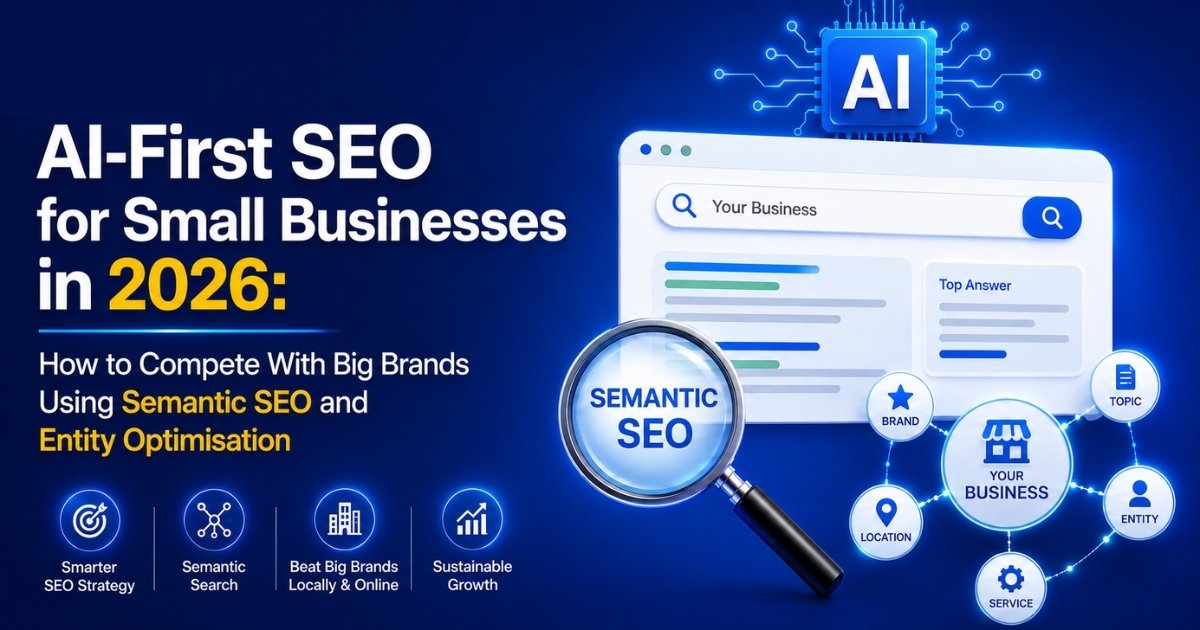
AI-generated answers are changing search behaviour in 2026, eclipsing traditional search listings. Now platforms like Google AI Overviews, ChatGPT, Gemini, and Perplexity evaluate semantic relationships, contextual relevance, and entity authority before delivering business information. This change has completely transformed the way businesses think about visibility across the modern search ecosystem.
For growing companies, AI SEO for small businesses has become increasingly important because discoverability now depends on whether AI systems can interpret expertise accurately. Smaller brands can no longer rely entirely on backlinks or isolated keyword placement. Search engines increasingly prioritise contextual depth, trustworthy information, and structured content capable of satisfying complete user intent.
Why Semantic SEO Is Leading Modern Search
Semantic SEO is all about meaning and contextual understanding, not keyword targeting. AI search systems can now analyse relationships between topics, industries, services, and user intent before picking sources for summaries and recommendations.
Businesses implementing AI SEO for small businesses are increasingly building topic clusters instead of fragmented pages targeting minor keyword variations. This structure improves topical authority while helping AI engines understand broader expertise across connected subjects.
Entity Optimisation Has Become Essential
Entity optimisation now plays a central role in search visibility because AI systems organise information through knowledge graphs and contextual entity associations. Businesses, industries, services, and locations are treated as interconnected entities rather than standalone keywords.
Effective AI SEO optimisation strengthens these relationships through structured schema, semantic content mapping, consistent business information, and contextual topic associations. AI systems compare signals across indexed content, citations, and website structure before determining expertise within a niche.
Businesses using AI SEO for small businesses are increasingly strengthening topical relevance through service pages, FAQs, educational blogs, and industry-focused resources. These strategies improve AI interpretation while increasing opportunities for inclusion inside conversational search responses.
Structured Content Improves AI Interpretation
Companies implementing AI SEO strategies are replacing lengthy promotional messaging with informative content focused on answering complete user questions. AI systems favour pages delivering contextual clarity without excessive filler or over-optimised language.
Schema implementation has also become increasingly important in 2026. FAQ schema, organisation schema, and service schema help search engines understand entity relationships more accurately. Structured data improves contextual interpretation while strengthening visibility across AI-generated summaries and conversational search experiences.
How Smaller Businesses Can Compete With Bigger Brands
Businesses investing in AI-driven SEO are focusing heavily on educational resources, topical authority, semantic relevance, and updated information. Detailed niche-focused pages frequently outperform broader corporate content lacking informational precision or contextual depth.
An experienced AI SEO Agency now focuses on semantic mapping, entity associations, structured optimisation, and AI discoverability instead of relying entirely on conventional ranking methods. This strategic shift allows smaller organisations to strengthen authority within specialised industries.
AI-based search engines are also increasingly important for freshness. Fresh content with better statistics, stronger context clues and accurate explanations will always beat old content. informational pages. AI systems increasingly reward trustworthy and easily interpretable information capable of supporting conversational search experiences.
Final Thoughts
Search optimisation in 2026 isn’t just about rankings and backlinks. Sustainable visibility is now about semantic relevance, contextual trust, structured expertise and entity optimisation that AI systems can confidently read. Companies that have adapted early to these changing search behaviours are positioning themselves for greater long-term discoverability in AI-first ecosystems. More and more organisations seeking cutting-edge optimisation strategies for direction are turning to Glowing Digital.
FAQs
Why is AI SEO for small businesses important in 2026?
Search engines increasingly prioritise AI-generated answers instead of traditional listings. AI SEO for small businesses helps companies improve semantic relevance, entity recognition, and contextual authority. Businesses using structured, trustworthy information are more likely to appear in conversational search responses, improving discoverability across evolving AI-driven platforms and highly competitive digital industries globally today.
How does AI SEO improve online visibility?
Modern AI SEO focuses on contextual understanding, topical authority, semantic relevance, and structured information instead of repetitive keyword placement. AI systems evaluate readability, expertise, and factual clarity before surfacing content within generated answers. Businesses implementing advanced optimisation strategies strengthen discoverability across conversational search experiences and evolving AI-powered search ecosystems online.
What makes AI SEO optimisation different from traditional SEO?
Traditional optimisation focused heavily on backlinks, rankings, and keyword density. AI SEO optimisation prioritises semantic relationships, entity associations, structured information, and contextual trust signals. AI systems assess whether content satisfies the complete user intent while evaluating facts. consistency, readability, and topical expertise before selecting information for conversational search responses online.
Why is structured content becoming more valuable online?
Structured content makes information easier to read and helps search engines understand the content accurately. Clear headings, concise explanations, semantic formatting and organised sections help to have a stronger contextual understanding. Structured pages generally improve engagement for businesses, as users are able to find answers more quickly, and AI systems of today are better at extracting information more efficiently in digital environments.
How often should businesses refresh website content?
Businesses should periodically review informational content for accuracy and contextual relevance. Pages that have been updated with better explanations, up-to-date stats, and better formatting tend to do better across changing search ecosystems. Regular updates also boost credibility, keeping organisations on their toes and helping them gain more long-term visibility in fast-changing digital environments around the globe.

Rajveer Mahmia
Rajveer Mahmia is the Founder & CEO of Glowing Digital, a global AI-first SEO agency serving 100+ businesses worldwide. Starting in 2021, he built the agency around the future of search—combining AI SEO, AEO, GEO, LLM SEO, and Google SGE. Rajveer helps brands gain visibility across Google and AI search platforms like ChatGPT, Gemini, and Perplexity through data-driven, intent-focused organic growth systems.


