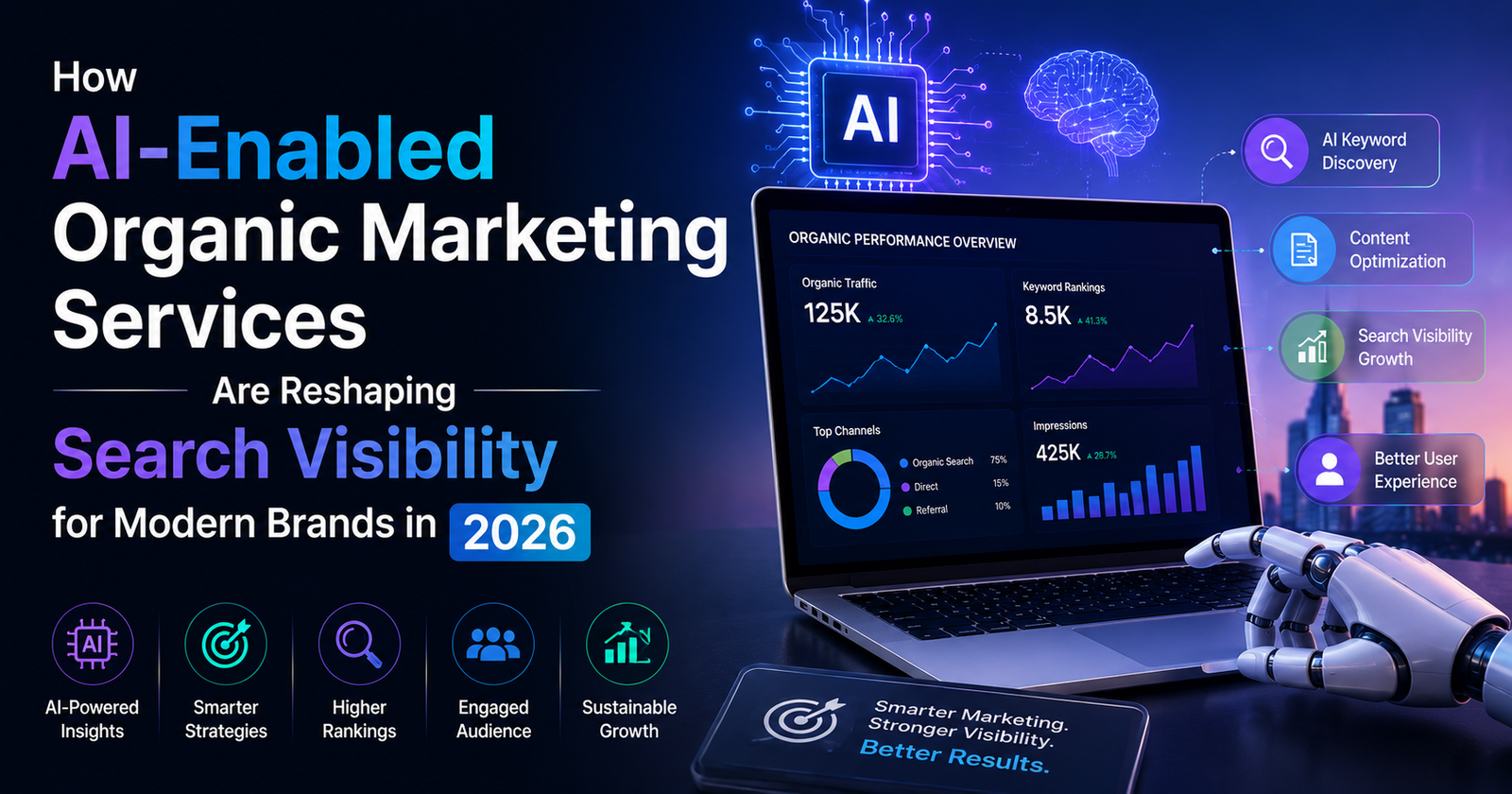
In 2026, search visibility is no longer driven by keywords alone. Search engines now evaluate user intent, topical authority, behavioural signals, and content usefulness at a far deeper level. This shift has accelerated the demand for AI-enabled organic marketing services, helping brands create scalable, data-informed strategies that improve rankings while maintaining authenticity.
Modern consumers expect highly relevant answers across search engines, AI summaries, voice search, and conversational interfaces. Businesses that rely on outdated optimisation tactics are steadily losing visibility. Instead, brands are investing in intelligent content ecosystems, predictive analytics, and AI-assisted optimisation to strengthen long-term discoverability and trust.
Why AI-Driven Organic Visibility Matters for Modern Search Growth
AI-enabled organic marketing services improve search visibility by combining machine learning, audience insights, and intent-focused content strategies. They help brands optimise content faster, identify ranking opportunities earlier, and align pages with evolving search behaviour across Google and AI-generated search experiences.
This approach strengthens authority, improves engagement metrics, and supports sustainable rankings without relying heavily on paid advertising.
The Shift from Traditional SEO to Intelligent Organic Growth
Traditional SEO focused heavily on static keywords, backlinks, and technical adjustments. While these remain important, modern algorithms now reward contextual relevance, semantic depth, and content credibility. AI tools help marketers analyse search intent patterns, monitor SERP volatility, and refine content performance continuously.
Brands are increasingly using AI to identify emerging search trends before competitors. Predictive optimisation allows businesses to publish content aligned with future demand rather than reacting after rankings decline. This proactive strategy creates stronger visibility across both conventional search and AI-generated summaries.
Another major change is content personalisation. Search engines increasingly favour pages that satisfy user expectations quickly and clearly. AI-driven analysis helps marketers understand audience behaviour, dwell time, and engagement signals more accurately, leading to more effective content structures and improved user journeys.
How Organic Marketing Is Becoming More Intelligent
Modern organic marketing strategies now integrate automation with human expertise. AI can assist with keyword clustering, competitor analysis, topical mapping, and content gap discovery in real time. However, successful brands still rely on experienced strategists and subject specialists to maintain accuracy, authority, and brand voice.
Search engines are also prioritising E-E-A-T principles – experience, expertise, authoritativeness, and trustworthiness. AI supports these goals by identifying weak content areas, detecting outdated information, and recommending updates that align with current search expectations.
Voice search and conversational search behaviour are further reshaping optimisation practices. Users now ask longer, intent-driven questions rather than typing fragmented keywords. AI helps marketers structure content naturally, improving relevance for conversational queries and featured snippets.
The Competitive Advantage of AI-Led SEO Strategies
Businesses adopting organic SEO with AI optimisation are seeing measurable improvements in content efficiency and ranking stability. AI-assisted workflows reduce manual research time while increasing precision across optimisation tasks. This allows teams to focus more on strategic planning, audience trust, and content quality.
At the same time, brands are recognising the importance of consistent publishing, technical health, and authoritative content ecosystems. AI tools can identify declining pages, recommend internal linking improvements, and detect ranking opportunities across multiple search formats simultaneously.
The future of search visibility depends on adaptability. Brands that combine intelligent automation with credible human-led strategy are better positioned to maintain long-term organic growth in an increasingly AI-driven digital environment.
The Takeaway
In 2026, effective organic SEO services are no longer limited to rankings alone. They focus on visibility, trust, relevance, and sustained audience engagement across evolving search experiences. Agencies such as Glowing Digital are adapting to these changes by aligning AI-driven optimisation with user-focused organic growth strategies designed for modern search behaviour.
FAQs :
1. How do AI-driven SEO strategies improve search rankings?
AI-driven SEO strategies analyse search intent, behavioural patterns, and ranking fluctuations faster than manual processes. This allows marketers to optimise content more accurately, improve technical performance, and identify emerging opportunities earlier. Many businesses now use AI-enabled organic marketing services to strengthen long-term visibility and improve user engagement across evolving search environments.
2. Is AI replacing human expertise in organic marketing?
AI is enhancing efficiency rather than replacing skilled marketers. Human expertise remains essential for strategic thinking, brand positioning, editorial quality, and trust-building. AI supports research, automation, and optimisation tasks, but successful campaigns still depend on experienced professionals who understand audience psychology, search intent, and credible content development.
3. Why is organic search still important in 2026?
Organic search remains important because users continue relying on search engines and AI-generated summaries for trusted information. Strong organic visibility builds credibility, supports sustainable traffic growth, and reduces dependence on paid advertising. Businesses investing in organic SEO services often benefit from stronger authority and improved long-term customer acquisition.
4. How does AI help with content optimisation?
AI helps marketers identify keyword relationships, content gaps, and engagement trends more efficiently. It can recommend structural improvements, semantic enhancements, and performance updates based on real-time search behaviour. Brands using organic SEO with AI optimisation can improve relevance, readability, and visibility while maintaining consistency across multiple digital channels.
5. What should brands prioritise for future organic growth?
Brands should prioritise authoritative content, technical website performance, user experience, and search intent alignment. Consistent publishing, accurate information, and audience trust are increasingly important for ranking stability. Businesses that adapt quickly to conversational search trends and evolving AI search experiences are more likely to achieve sustainable visibility growth.

Rajveer Mahmia
Rajveer Mahmia is the Founder & CEO of Glowing Digital, a global AI-first SEO agency serving 100+ businesses worldwide. Starting in 2021, he built the agency around the future of search—combining AI SEO, AEO, GEO, LLM SEO, and Google SGE. Rajveer helps brands gain visibility across Google and AI search platforms like ChatGPT, Gemini, and Perplexity through data-driven, intent-focused organic growth systems.


