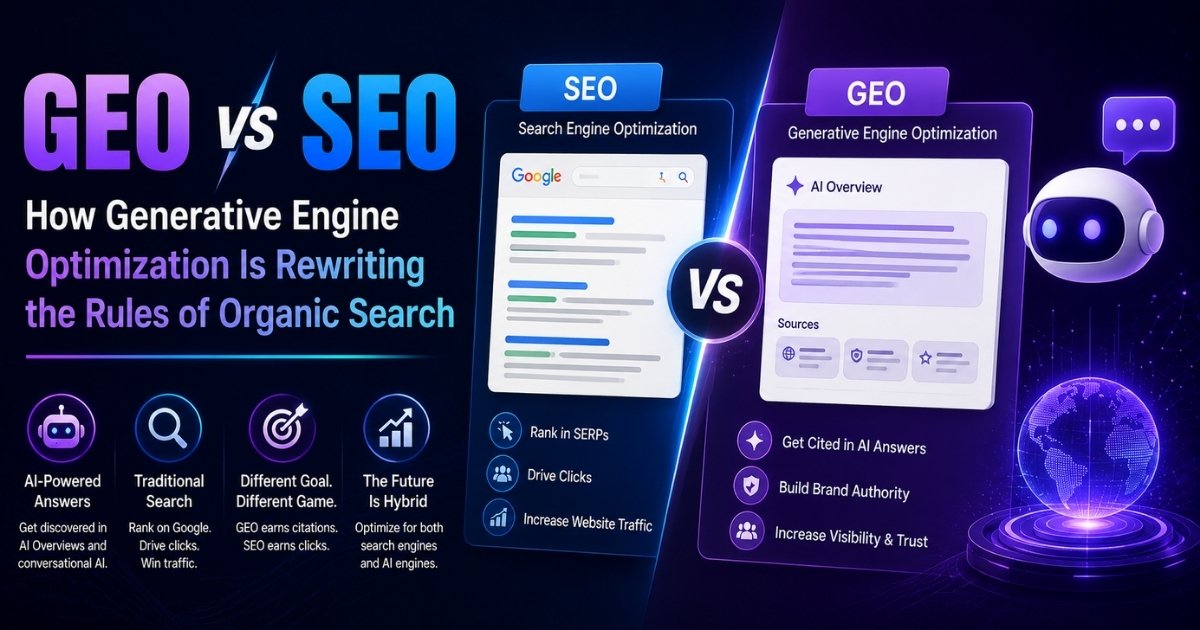
Search behaviour in 2026 is increasingly shaped by AI-generated responses rather than traditional search listings. Users now expect direct, contextual answers from platforms such as ChatGPT, Google AI Overviews, Gemini, and Perplexity. This shift has accelerated the rise of GEO as businesses adapt content strategies for AI-driven discovery instead of relying solely on rankings.
Understanding the Difference Between GEO and SEO
Traditional SEO focuses on improving rankings across search engine results pages through keywords, backlinks, technical optimisation, and authority signals. Generative Engine Optimisation (GEO) expands this approach by optimising content for inclusion within AI-generated answers.
Instead of competing only for clicks, brands now compete for citations, summaries, and contextual references generated by AI systems. Search visibility is no longer restricted to blue links. AI platforms synthesise information from multiple trusted sources before presenting a final response to users.
Unlike conventional optimisation, GEO prioritises contextual understanding, factual accuracy, and semantic relationships. AI engines increasingly evaluate how effectively content satisfies user intent rather than matching isolated search terms.
Why AI Search Has Changed Organic Visibility
AI-driven search engines prioritise contextual understanding over isolated keyword matching. Users increasingly search using conversational queries, detailed prompts, and multi-step questions. This behavioural shift has made topical depth and content reliability more important than repetitive optimisation tactics.
Modern AI systems evaluate structure, readability, factual consistency, and entity relevance before selecting sources. As a result, websites using Generative SEO strategies are focusing on expertise, topical authority, and extractable answers rather than relying entirely on traffic-based ranking methods.
Content designed for AI discovery often includes concise summaries beneath headings, question-based formatting, updated statistics, and structured schema markup. These elements improve interpretation for both users and generative engines while strengthening long-term GEO performance across competitive industries.
How Businesses Are Adapting to Generative Search
Successful brands in 2026 are integrating SEO and Generative AI SEO into a unified strategy instead of treating them separately. Technical SEO still supports indexing, crawlability, and authority, but AI optimisation introduces additional priorities focused on content comprehension.
Instead of trying to hit long-tail search phrases, writers are creating pages that answer full user intent. The chances of being included in AI-generated summaries increase with clear formatting, semantic relevance and credible sources.
The Growing Importance of Structured Content
Structured content has become central to GEO because AI systems extract information more effectively from organised pages. Clear heading hierarchies, concise paragraph structures, FAQ sections, and schema markup help generative engines understand relationships between topics.
Companies are also building out entity-based content strategies that create topical associations across websites. It enhances AI systems’ ability to identify expertise, authority and contextual relevance in highly competitive digital spaces.
The Future of Search Optimisation
Search optimisation is evolving from ranking-focused visibility towards answer-focused discoverability. Traditional SEO continues to support technical performance, but Generative Engine Optimization (GEO) is reshaping how brands appear across AI-powered search experiences.
As AI systems become more embedded in everyday search behaviour, businesses need to focus on structured expertise, factual consistency and user-centric content design. Early adopters will future-proof long-term discoverability and ensure relevance in ever-more intelligent search ecosystems.
Final Thoughts
The evolution of AI-driven search has transformed how businesses approach organic visibility in 2026. Companies can no longer depend entirely on rankings and keyword placement alone. Sustainable visibility now requires trustworthy, structured, and context-rich content that AI systems can interpret confidently. Businesses seeking advanced guidance in this evolving landscape are increasingly exploring strategic support from Glowing Digital.
FAQs :
1. What makes GEO different from traditional SEO practices?
Traditional SEO improves rankings within search results, while GEO improves visibility inside AI-generated responses. It prioritises structured information, contextual relevance, topical authority, and extractable answers that AI systems reference confidently. Both strategies support discoverability, but AI-focused optimisation increasingly shapes how businesses appear across conversational search environments and recommendation platforms online.
2. Why is Generative Engine Optimization (GEO) important for businesses in 2026?
AI-powered search platforms increasingly answer queries directly without users visiting multiple websites. Generative Engine Optimization (GEO) helps businesses remain visible within generated responses. Companies using AI-focused optimisation improve discoverability, strengthen credibility, and maintain stronger positioning across conversational search experiences. This approach supports visibility as AI-driven recommendation systems continue expanding globally.
3. Does schema markup still matter for AI-focused search visibility?
Schema markup remains relevant because it helps AI systems understand the context of a webpage appropriately. Structured data helps us better understand articles, FAQs, organisations and services and makes it easier to extract content in generated responses. A well-implemented schema also helps businesses by improving indexing, reinforcing topic relationships, and enhancing visibility in the evolving world of AI-powered search.
4. How does Generative SEO influence content writing strategies?
Generative SEO encourages businesses to create content answering complete user intent instead of isolated keyword phrases. Writers now prioritise clarity, semantic relevance, factual consistency, and conversational structure. AI systems favour content delivering trustworthy insights quickly while maintaining readability, topical depth, and relationships. This improves discoverability across AI-driven search platforms globally.
5. Can smaller businesses compete effectively in AI-driven search environments?
Smaller businesses can compete successfully by publishing specialised, accurate and consistently updated content. AI systems typically value expertise, clarity of thought, and contextual relevance over the size of the company. By emphasising audience intent, authoritative information, and structured formatting, businesses can significantly increase visibility in competitive digital markets and rapidly changing industries across the globe.

Rajveer Mahmia
Rajveer Mahmia is the Founder & CEO of Glowing Digital, a global AI-first SEO agency serving 100+ businesses worldwide. Starting in 2021, he built the agency around the future of search—combining AI SEO, AEO, GEO, LLM SEO, and Google SGE. Rajveer helps brands gain visibility across Google and AI search platforms like ChatGPT, Gemini, and Perplexity through data-driven, intent-focused organic growth systems.


