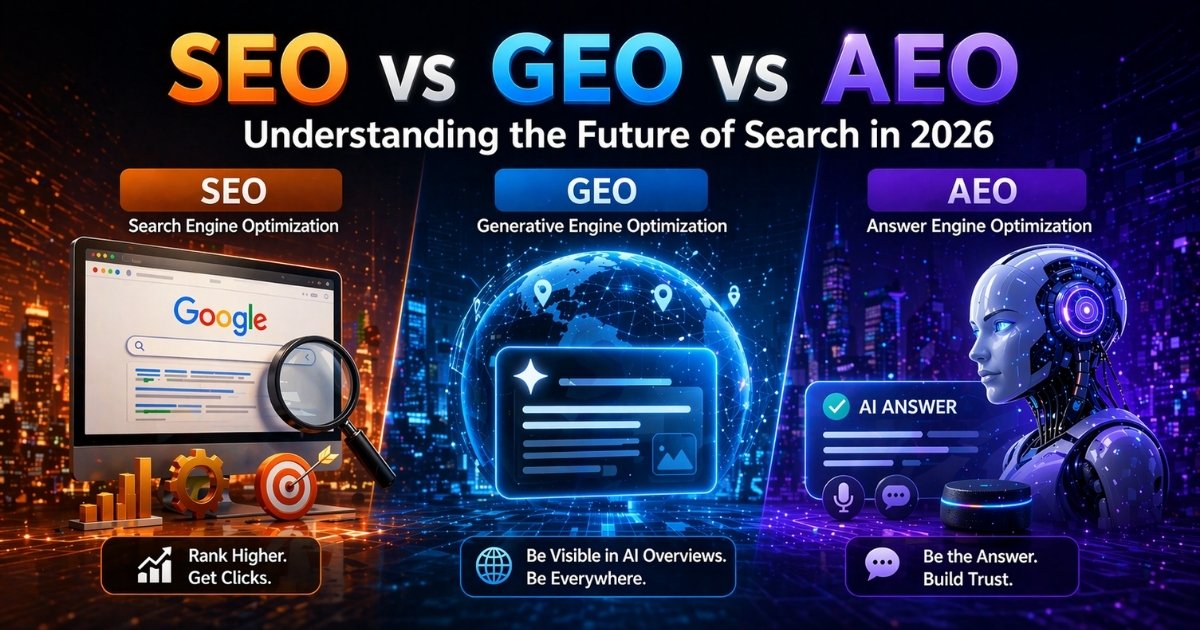
SEO vs GEO vs AEO: Understanding the Future of Search in 2026
Search is evolving faster than ever. With AI-driven platforms, voice assistants, and generative engines reshaping how users find information, businesses must rethink their strategies. The debate around SEO vs AEO vs GEO is no longer theoretical – it’s essential for staying visible in 2026 and beyond.
The Evolution of Search
Traditional search engines have long relied on ranking web pages based on relevance, backlinks, and keywords. However, user behavior is shifting toward instant answers, conversational queries, and AI-generated responses. This transformation is shaping the Future of search engines 2026, where users expect precise, context-aware results without clicking multiple links.
What is SEO Today?
Search Engine Optimization (SEO) remains the foundation of digital visibility. It focuses on optimizing websites for search engines like Google through technical improvements, content quality, and authority building. While SEO is still critical, it now works alongside newer optimization strategies rather than standing alone.
What is AEO in SEO?
To understand modern search, it’s crucial to explore what is AEO in SEO. Answer Engine Optimization (AEO) focuses on providing direct, concise answers to user queries. Instead of just ranking pages, AEO aims to position content for featured snippets, voice search results, and AI assistants.
For example, when users ask questions through voice search, they expect immediate answers. AEO ensures your content is structured in a way that search engines can easily extract and deliver those answers.
Understanding Generative Engine Optimization (GEO)
A newer concept gaining traction is Generative Engine Optimization (GEO). GEO focuses on optimizing content for AI-driven platforms like ChatGPT, Google’s AI Overviews, and other generative engines that synthesize information instead of listing links.
Unlike traditional SEO, GEO prioritizes:
- Contextual relevance
- Authority and trustworthiness
- Structured and comprehensive content
As AI tools become primary sources of information, GEO will play a crucial role in ensuring your brand is included in generated responses.
Key Differences Between SEO, AEO, and GEO
While these strategies overlap, they serve different purposes:
- SEO: Focuses on ranking web pages in search engine results
- AEO: Targets direct answers and voice search queries
- GEO: Optimizes content for AI-generated responses
Together, they create a holistic approach to search visibility.
Why Businesses Must Adapt
The shift toward AI-powered search is not a trend – it’s a fundamental change. Users increasingly rely on voice assistants and AI tools for quick answers. This means businesses must diversify their strategies to stay competitive.
Relying only on traditional SEO can limit your reach. By integrating AEO and GEO, brands can appear in multiple touchpoints, including featured snippets, voice responses, and AI-generated summaries.
Building a Future-Ready Strategy
To succeed in 2026, businesses should:
- Create high-quality, authoritative content
- Structure information for easy extraction
- Focus on user intent and conversational queries
- Build trust through credible sources
Combining these elements ensures visibility across traditional and AI-driven platforms.
Final Thoughts
The search landscape is rapidly transforming, and understanding SEO vs AEO vs GEO is key to staying ahead. Businesses that embrace all three strategies will be better positioned to capture attention across evolving platforms. Companies like Glowing Digital are already helping brands navigate this shift, ensuring they remain competitive in the ever-changing digital ecosystem.
FAQs
1. What is the main difference between SEO, AEO, and GEO?
SEO focuses on improving website rankings on search engines through keywords and backlinks. AEO targets direct answers for voice and featured snippets. GEO optimizes content for AI-generated responses, making it suitable for modern platforms that summarize and generate information instead of listing traditional search results.
2. Why is AEO important in 2026?
Understanding what is AEO in SEO is crucial because users increasingly rely on voice search and instant answers. AEO helps businesses appear in featured snippets and assistant responses, improving visibility without requiring users to click links, which aligns with modern search behavior trends globally.
3. How does Generative Engine Optimization work?
Generative Engine Optimization (GEO) works by creating structured, authoritative, and context-rich content that AI tools can easily interpret. It ensures your information is included in AI-generated summaries, helping brands stay visible even when users rely on conversational or generative search platforms for answers.
4. Is traditional SEO still relevant in the future?
Yes, SEO remains a strong foundation for online visibility. However, it must evolve alongside AEO and GEO. Businesses that combine all three strategies can adapt to the Future of search engines 2026, ensuring they reach users across traditional, voice, and AI-driven search experiences effectively.
5. How can businesses prepare for future search trends?
Businesses should focus on high-quality content, structured data, and user intent. Optimizing for voice queries and AI platforms is essential. A combined strategy using SEO, AEO, and GEO ensures better reach, helping brands remain competitive as search continues shifting toward intelligent, automated, and conversational systems.

Rajveer Mahmia
Rajveer Mahmia is the Founder & CEO of Glowing Digital, a global AI-first SEO agency serving 100+ businesses worldwide. Starting in 2021, he built the agency around the future of search—combining AI SEO, AEO, GEO, LLM SEO, and Google SGE. Rajveer helps brands gain visibility across Google and AI search platforms like ChatGPT, Gemini, and Perplexity through data-driven, intent-focused organic growth systems.


