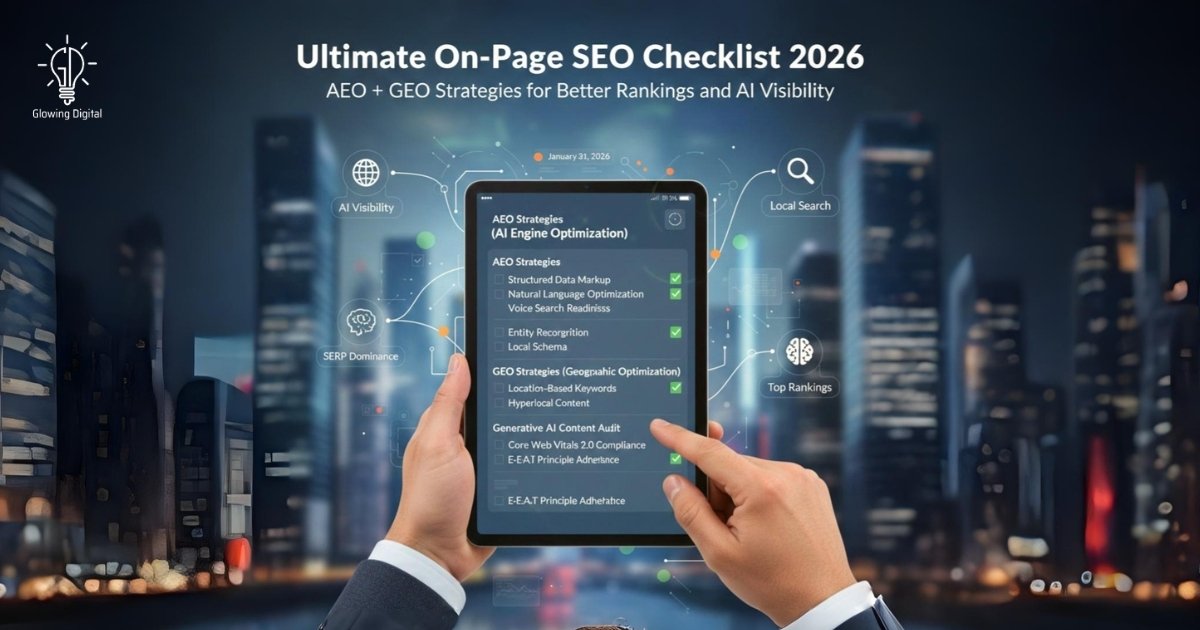
Search engines are no longer just ranking links – they are answering questions, generating summaries, and personalizing results using AI. To stay competitive, brands must evolve beyond traditional SEO tactics. This on-page SEO checklist 2026 is designed to help marketers, founders, and content teams optimize pages not only for classic rankings but also for AI-driven discovery, answer engines, and generative search platforms. Below is a future-ready framework that blends proven fundamentals with emerging optimization models.
1. Search Intent Mapping for AI-Driven Results
Before optimizing any page, clearly map user intent: informational, navigational, transactional, or conversational. In 2026, intent clarity is critical because AI systems summarize and reframe content based on perceived usefulness. Structure your content so each section answers a specific sub-intent, making it easier for AI and voice assistants to extract accurate responses.
2. What Is AEO SEO? And Why It Matters
Answer Engine Optimization focuses on structuring content so it can be directly used by answer engines, featured snippets, and AI overviews. Effective AEO SEO optimization includes concise definitions, schema markup, question-based subheadings, and clear step-by-step explanations. This improves your chances of being cited or summarized by AI systems instead of just ranked as a blue link.
3. How to Optimize Content for GEO in 2026
How to optimize content for GEO in 2026 starts with understanding Generative Engine Optimization. A strong GEO SEO strategy ensures your content is comprehensive, entity-rich, and context-aware so generative AI models can confidently reference it. This means using consistent terminology, covering related subtopics, and reinforcing topical authority across your site.
4. Advanced On-Page Content Structuring
Use a clean hierarchy with one H1, logical H2s, and scannable H3s. Short paragraphs, bullet points, and comparison tables help both users and AI parse information efficiently. Internal linking between related articles strengthens semantic relationships and reinforces topical depth without keyword stuffing.
5. Technical On-Page Essentials Still Matter
While AI is changing search behavior, fundamentals remain essential. Optimize title tags for clarity, write compelling meta descriptions, compress images, and ensure fast load times. Core Web Vitals, mobile usability, and crawlability remain ranking enablers that support all advanced SEO strategies.
6. Aligning Content with SEO Trends 2026
Emerging SEO trends 2026 emphasize entity-based search, conversational queries, and trust signals like author credibility and transparent sourcing. Updating older content, adding expert insights, and maintaining factual accuracy help your pages remain relevant as algorithms prioritize reliability and freshness.
7. Optimizing for AI Search Experiences
An effective AI search SEO guide approach includes writing in natural language, answering follow-up questions within the content, and avoiding vague or overly promotional copy. AI systems favor content that is clear, neutral, and genuinely helpful, especially for educational and how-to topics.
Key Takeaways
1. What is on-page SEO and why is it important in 2026?
On-page SEO refers to optimizing individual web pages to improve rankings and user experience. In 2026, it is more important than ever because search engines rely heavily on content structure, clarity, and intent signals to feed AI-generated results and answer engines.
2. How does AEO differ from traditional SEO?
Traditional SEO focuses on rankings, while AEO SEO optimization focuses on being the best direct answer. AEO prioritizes structured content, schema, and concise explanations so AI systems can confidently extract and present your information to users.
3. How can I optimize my content for AI-powered search engines?
To optimize for AI-powered search, write clearly, answer common questions directly, use logical headings, and maintain topical depth. An AI search SEO guide approach ensures your content is easy for AI models to understand, summarize, and cite accurately.
4. What is GEO and why is it important for SEO in 2026?
Generative Engine Optimization ensures your content can be used by AI models to generate responses. A strong GEO SEO strategy increases the likelihood that your brand is referenced in AI-generated answers rather than being overlooked in favor of competitors.
5. What are the most important SEO trends to follow in 2026?
Key SEO trends 2026 include entity-based optimization, conversational content, trust signals, and AI-friendly formatting. Businesses that align with these trends are more likely to gain visibility across search engines, voice assistants, and generative AI platforms.
Rajveer Mahmia
Rajveer Mahmia is the Founder & CEO of Glowing Digital, a global AI-first SEO agency serving 100+ businesses worldwide. Starting in 2021, he built the agency around the future of search—combining AI SEO, AEO, GEO, LLM SEO, and Google SGE. Rajveer helps brands gain visibility across Google and AI search platforms like ChatGPT, Gemini, and Perplexity through data-driven, intent-focused organic growth systems.


