4B, Dr. Martin Luther King Sarani (Wood Street), 2nd Floor, Kolkata – 700016

Subscription Form

Search has changed more in the last couple of years than it did in the decade before that. Not long ago, ranking on the first page of Google was the main goal for most businesses. If your website appeared near the top of the search results, you were in a strong position to attract traffic and generate enquiries. Today, things look a little different.

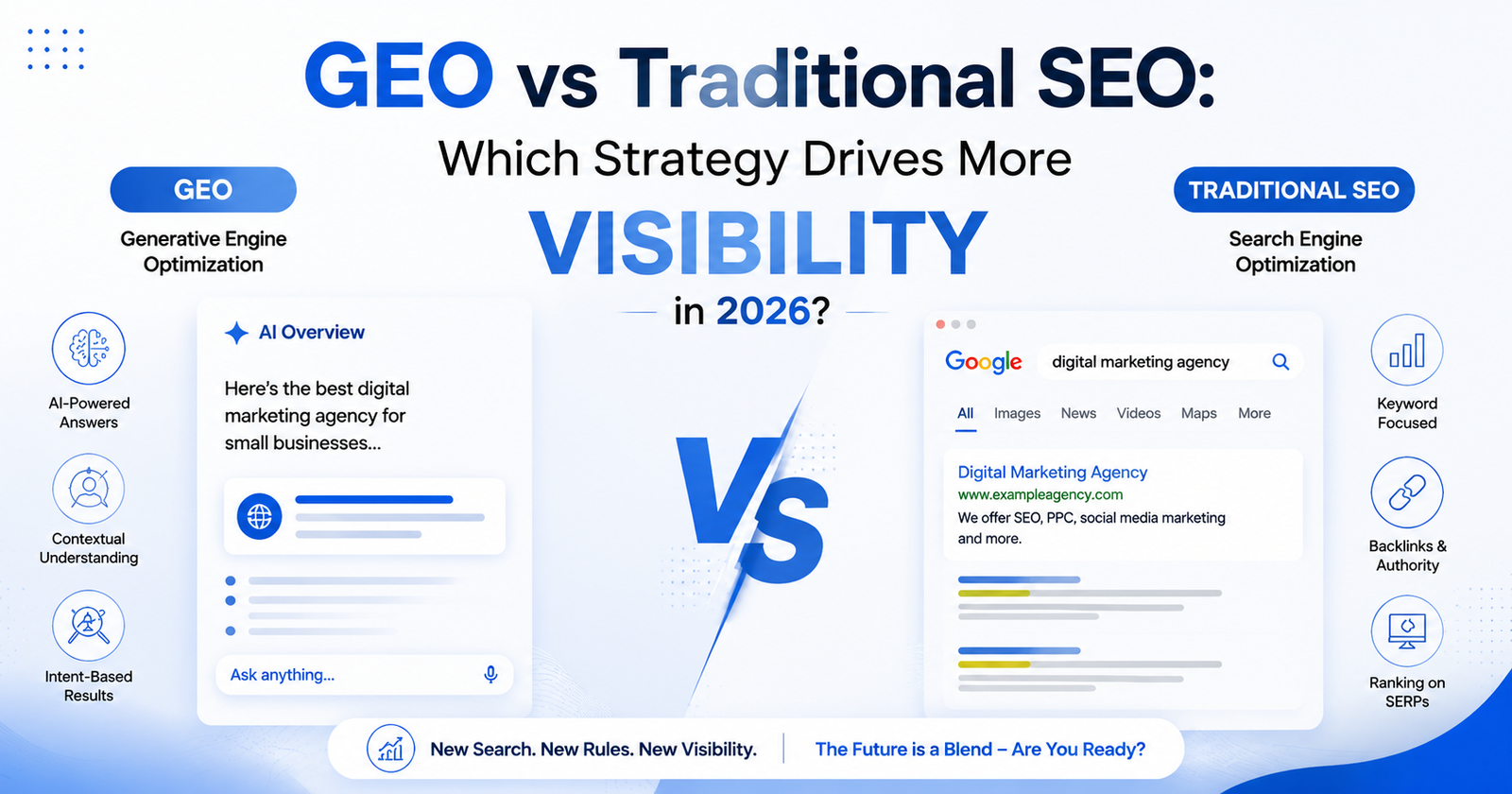
People are asking questions directly to AI-powered search tools, expecting complete answers instead of scrolling through pages of links. Search engines are evolving, and so are the ways businesses need to think about online visibility. That’s exactly why conversations around GEO vs SEO have become much more common. Businesses are beginning to ask whether traditional SEO is still enough or whether newer strategies are needed to stay visible in an AI-driven search landscape. 

Why GEO vs SEO Is Becoming Such An Important Discussion

Traditional SEO has been the foundation of online marketing for years. The goal has always been simple: optimise a website so that search engines understand its content and rank it for relevant searches. Businesses have focused on keywords, technical improvements, backlinks, user experience, and valuable content to improve rankings. That hasn’t suddenly become irrelevant.

What has changed is how people search. AI-powered search experiences now generate direct answers by pulling information from multiple trusted sources instead of simply displaying a list of websites. This shift has introduced a completely new layer to digital marketing. That’s where generative engine optimisation comes into the conversation. For businesses looking ahead, understanding both approaches is becoming increasingly important.

Traditional SEO Still Delivers Strong Results

Despite all the discussion around AI, traditional SEO continues to provide significant value. Millions of people still search through Google every day. They compare products, read blogs, visit websites, and research services before making decisions.

A well-optimised website remains one of the strongest long-term marketing assets a business can have. Technical performance, useful content, mobile optimisation, and high-quality backlinks all continue to influence organic search performance. In other words, traditional SEO isn’t disappearing. It’s evolving.

AI Is Changing How People Discover Information

Think about how many people now ask AI assistants complex questions instead of typing short search phrases. Instead of searching for “best running shoes”, someone might ask, “What are the best running shoes for beginners with flat feet?” AI tools respond differently from traditional search engines.

Rather than showing ten blue links, they generate a detailed answer using information gathered from trusted online sources. This growing trend has made AI search marketing increasingly relevant for businesses that want to remain visible across emerging search platforms. It’s no longer just about being found. It’s about being referenced.

Visibility Means More Than Rankings

For years, businesses measured their success by checking keyword rankings. Rankings are still important, but they no longer tell the entire story. Traditional search engines, artificial intelligence-generated responses, voice search, featured snippets, and knowledge panels all make up today’s online presence.

That’s why many businesses are expanding their overall search visibility strategy instead of focusing solely on organic rankings. The goal is simple. Appear wherever customers are searching, regardless of the platform they’re using. Businesses that diversify their visibility are likely to remain more competitive as search behaviour continues to change.

The Smartest Businesses Are Combining Both Approaches

This isn’t really a debate where one strategy replaces the other. It’s about balance. Traditional SEO continues building strong website authority, while newer optimisation techniques help businesses adapt to AI-powered search experiences.

When combined, they produce a digital marketing strategy that is more robust. Many businesses are investing in both to get ready for shifting consumer behaviour rather than picking just one. This strategy increases chances for long-term online visibility while lowering risk.

Preparing For The Future Starts Today

Waiting until search changes completely probably isn’t the best approach. Businesses that start adapting early usually have more time to build authority, improve content quality, and understand how AI-powered search platforms are evolving.

That’s one reason discussions around GEO vs SEO are becoming increasingly important among marketers and business owners alike. The businesses that stay flexible today are often the ones that remain visible tomorrow.

Final Thoughts

A list of blue links is no longer the only way to search. Businesses must look beyond traditional rankings and concentrate on how their content is found, comprehended, and referenced across various search experiences as AI-powered platforms proliferate. This does not imply that traditional SEO is no longer useful. It remains an essential part of building long-term authority and organic traffic. At the same time, generative engine optimisation is opening new opportunities for brands to appear in AI-generated responses and reach users in different ways.

If you’re looking to build a search strategy that adapts to changing user behaviour and emerging AI search experiences, Glowing Digital helps businesses stay ahead with data-driven, future-focused digital marketing solutions.

FAQs

1. What is the difference between GEO and SEO?

The main difference is that GEO vs SEO focuses on two different search environments. Traditional SEO helps websites rank on search engines, while GEO aims to improve a brand’s chances of being referenced within AI-generated responses. Together, they create a broader approach to online visibility in today’s evolving search landscape.

Absolutely. Traditional SEO continues to drive organic traffic, improve website authority, and support long-term digital growth. While AI-powered search is becoming more popular, millions of users still rely on conventional search engines every day, making SEO an essential part of any successful online marketing strategy.

AI search marketing helps businesses optimise content for AI-powered search platforms that generate direct answers instead of listing only website links. By creating trustworthy, well-structured content, brands increase their chances of being referenced in AI responses, improving visibility across emerging search experiences.

No. Rather than replacing one strategy with another, businesses should combine both approaches. Traditional SEO continues to build authority and attract organic traffic, while newer optimisation methods support visibility across AI-driven platforms. Using both together creates a stronger and more adaptable long-term digital marketing strategy.

The future of SEO is changing because user behaviour is evolving alongside AI technology. More people now expect direct, conversational answers instead of browsing multiple websites. Businesses that adapt their content and optimisation strategies early are more likely to remain visible as search continues to evolve.

Rajveer Mahmia

Rajveer Mahmia is the Founder & CEO of Glowing Digital, a global AI-first SEO agency serving 100+ businesses worldwide. Starting in 2021, he built the agency around the future of search—combining AI SEO, AEO, GEO, LLM SEO, and Google SGE. Rajveer helps brands gain visibility across Google and AI search platforms like ChatGPT, Gemini, and Perplexity through data-driven, intent-focused organic growth systems.